Europe’s e-invoicing operators want to see a connected digital ecosystem for trade, one where businesses and service providers can find each other, exchange data seamlessly and scale across borders.
But will it remain an unfulfilled hope?
At the e-invoicing conference Exchange Summit in Berlin, several positive signs were noted, but they are unfortunately overshadowed by national one-off solutions and a stubborn dependence on traditional PDF formats.Henrik Möller, Regulatory Intelligence Specialist at Inexchange, observes that developments in Europe are out of step. One step forward is followed by one step back.
“Regulatory requirements are spreading explosively. The dilemma is that each individual country considers its own internal solution to be the best answer to a problem that all countries share. Just look at Poland and France, or how Spain plans to do it. Internal variants are being created instead of adopting a standard that could work everywhere.”
"The drivers for digitalisation differ"
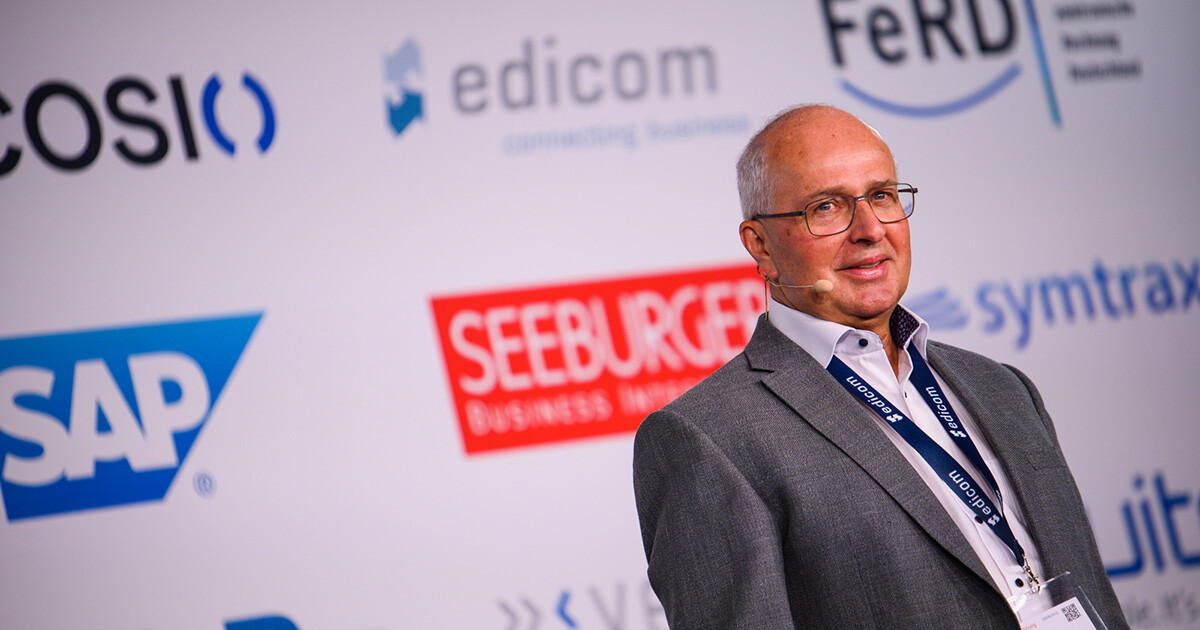
Exchange Summit in Berlin ran for three days (30 September–2 October) and was sponsored by Inexchange as well as by GENA (Global Exchange Network Association), the joint body of e-invoicing operators. Henrik chairs the organisation’s Nordic chapter. He took part in a panel debate focused on the implementation of national mandates and the latest insights and recommendations.
The fragmentation that arises when countries enact their own laws to secure tax revenue, rather than focusing on efficiency, was inevitably raised by the panel on stage.
“The drivers for digitalisation differ across Europe. In the Nordics, tax compliance is high. For us, the tax gap isn’t a major problem. Our driver is automation and efficiency. We focus on how we can make things more convenient,” says Henrik Möller, comparing this with countries further south on the continent that take a different view:
“In their case, tax revenue is priority number one. Their driver is securing the tax base. My sense is that this stance slows down, or at least dampens, the appetite for innovation. The focus is on collecting the tax. Once a system meets that goal, interest in everything else cools. Efficiency and the rest come second.”
A light in the horizon
The countries would need to agree on a shared approach, but Henrik Möller sounds pessimistic about the chances of reaching consensus.
“ViDA is definitely a light on the horizon, but before the reform takes full effect, I think many countries will have time to launch internal initiatives to solve problems they regard as their own, but which are really shared by everyone.”
Henrik elaborates:
“Because the tax issue dominates, ViDA at this stage is not a strong lever for technical development. ViDA covers cross-border trade and allows countries to introduce mandatory e-invoicing, but when it comes to technical solutions, the directive is of relatively little help. That work will fall to the service providers, and it is under way. Substantial effort is going into creating the trade ecosystem that everyone is so keen to achieve.”
"ViDA covers cross-border trade and allows countries to introduce mandatory e-invoicing, but when it comes to technical solutions, the directive is of relatively little help. That work will fall to the service providers."
Henrik Möller, Regulatory Intelligence Specialist, Inexchange
“Belgium has been a pioneer in e-invoicing, even though their solution has its drawbacks. But they have stuck to standards, standards and more standards. Belgium has shown how it can and should be done. Then there’s Norway, which was early with Peppol and has established e-invoicing even though the national B2B mandate won’t be introduced until next year,” says Henrik Möller, adding:
“I also have high hopes for Slovakia. Slovakia also has a Peppol solution in which tax reporting is included in a five-corner model. When their e-invoicing law comes into force from 2027, they will, as I understand it, rely on Peppol technology throughout. It’s not a huge country, but it’s a good start for showing that this is a solution that works.”
Could the UK’s intention to use Peppol mean a breakthrough?
“There is symbolic value in a non-EU country choosing Peppol. But for it to have practical significance, it mustn’t come with a host of complicated rules and conditions. My understanding of the UK is that it is an administratively heavy country. If they choose to focus on Peppol, that’s great, but it could end up like France, which is also a major Peppol user. There, they’ve added lots of technical solutions that don’t make things easier for anyone.”
It’s tragic that PDF is still around
Finally, there is one more obstacle that Henrik Möller feels he must raise: the PDF invoice.
“Yes, there is a surprising amount of talk about PDF. Sure, PDF is huge in strong economies like Germany, France and Spain, so it’s perhaps not strange that it’s still in focus, but the fact that it’s still being sent in the belief that it’s some kind of hybrid e-invoice is tragic.”
“At the same time, it’s a reminder of how great the differences across Europe still are. Up here in the north, we are ten years ahead of other markets in this respect,” Henrik Möller emphasises.
Caption: Henrik Möller (far right) participated in a panel discussion in Berlin alongside the chairs of GENA’s local chapters and moderator Christiaan van der Valk (far left). The others pictured are Antonis Ntinos, Susie West, Enrico Liverani, and Richard Luthardt. Photo: Per Löfving, Inexchange