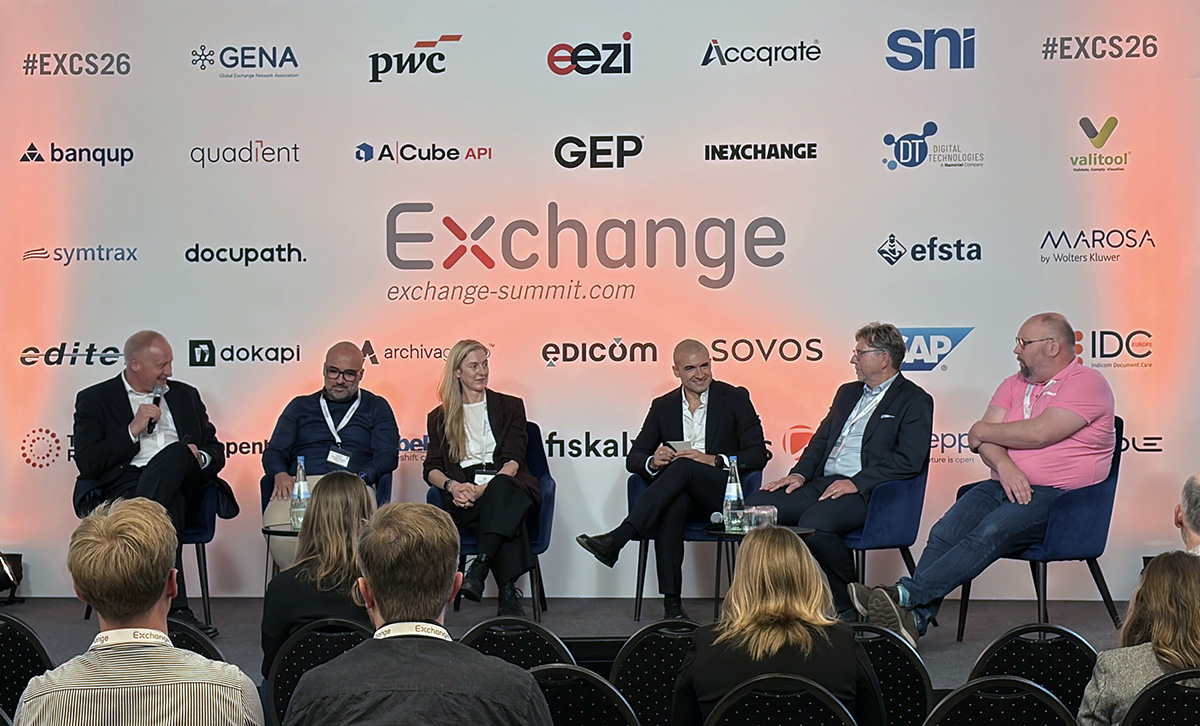
Borderless ambitions but national obstacles
Europe’s e-invoicing operators want to see a connected digital ecosystem for trade, one where businesses and service...

The e-invoice in Europe
Slovenia is well on its way to full digital invoice processing. Since 2015, e-invoicing is mandatory for trade with the public sector. The country's eSlog standard is widely used in the B2G sector.
In the private sector, e-invoicing is still voluntary, but its use is growing rapidly. The government has decided to take the next step. From 2028, e-invoicing will be mandatory for all businesses. With this provision, Slovenia is expected to reach a high level of automation and transparency in its invoicing process, in line with the EU's goals for digitalization and VAT reporting.
Digital developments are moving fast and are being accelerated by the ViDA reform, which will make e-invoicing mandatory for all cross-border transactions within the EU from July 2030.
This guide presents the domestic situation regarding e-invoicing in each country.

Since January 1, 2015, e-invoicing has been mandatory for business-to-business and business-to-government transactions. eSlog is a national standard built on XML variants UBL 2.1 and UN/CEFACT CII D16B. Since 2019, Peppol BIS 3.0 is also allowed. The national Public Payments Administration (UJP) platform was then linked to the Peppol network.

In October 2025, the Slovenian Parliament agreed to approve mandatory e-invoice reporting for B2B transactions by domestic businesses from 1 January 2028. This is one year later than originally intended.

For B2G transactions, EN-compliant e-invoices are required, which more specifically means eSlog 2.0 or Peppol BIS.
Europe’s e-invoicing operators want to see a connected digital ecosystem for trade, one where businesses and service...

The path forward as one unified company was announced back in June. Four months on, the newly merged Inexchange is...

Sending and receiving e-invoices is becoming more and more common, but it can still quite often be perceived as messy...