.svg)
.svg)
The e-invoice has matured to the point where it now fulfills far more tasks than just complying with digital rules. It is becoming the backbone of modern business transactions and a key building block of integrated digital commerce.
This is the conclusion of a new report, 'Riding the Tornado: A guide to mastering multinational e-invocation and compliance', just released by analyst firm Billentis and its owner and CEO, Marcus Laube.
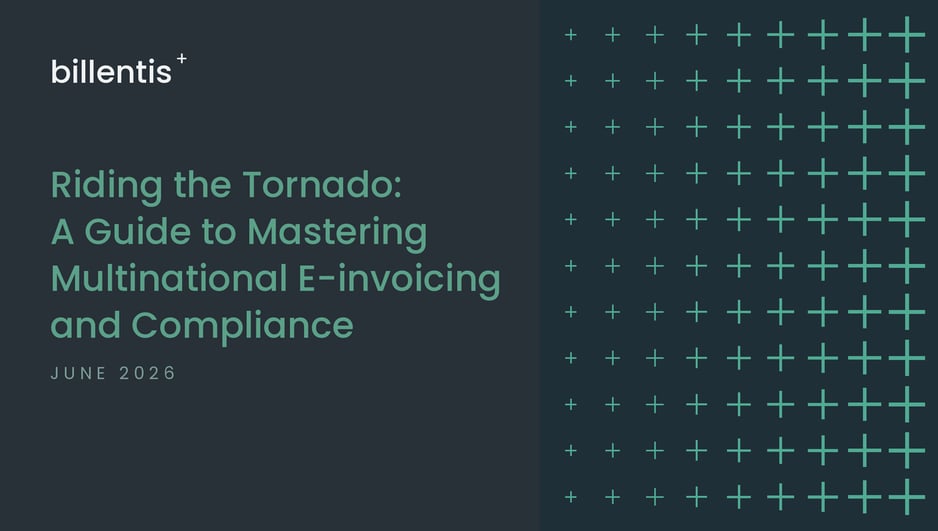
Billentis, which has established itself as one of the industry's most influential independent voices for more than two decades, is behind the report. The annual study has grown into a barometer for the entire e-invoicing market and is widely cited by suppliers, authorities and businesses.
Founded by e-invoicing mogul Bruno Koch, Billentis was taken over in 2023 by Marcus Laube - founder of e-invoicing and payments company Crossinx - who broadened the analysis from pure e-invoicing to include compliance, finance, procurement and digital commerce.
Billions of invoices up sharply
Globally, around 560 billion invoices are exchanged every year. Of the approximately 300 billion B2B invoices, around 87 billion, or 29%, are expected to be electronic in 2026. The electronic volume is predicted to increase from 88 billion in 2026 to 107 billion in 2030, by which time e-invoices are expected to have become the dominant way of exchanging business data in most major economies.
The main driver is tax authorities. More and more countries are introducing mandatory e-invoicing and Continuous Transaction Control (CTC) models to close the tax gap. In the EU, the VAT in the Digital Age (ViDA) initiative is expected to generate up to €111 billion in additional VAT revenue while reducing compliance costs for businesses by around €41 billion.
Proactivity creates a head start
The report describes how the original 'e-invoicing tornado' is now growing into something bigger: Integrated Digital Trade (IDT). Structured business data connects buyers, suppliers, banks, logistics companies and governments, merging invoicing, tax reporting, purchasing and payments.
Artificial intelligence is highlighted as the next big enabler. From document management and data extraction to compliance monitoring and predictive analytics.
For businesses, this means increased complexity, but also great opportunities. Billentis warns against treating requirements as isolated country projects. Such initiatives, which are becoming increasingly common, risk leading to fragmented systems and rising costs.
Instead, he recommends centralized governance, harmonized processes and flexible technology that can handle multiple countries' regulations. Those who act proactively stand to gain in terms of lower costs, better data quality, stronger collaboration and a foundation for AI-driven automation.
Valuable guide
Inexchange is a partner of Billentis and you can download the comprehensive report "Riding the Tornado: A guide to mastering multinational e-invocing and compliance" free of charge via the link below.
The 147-page report provides insights into, among other things:
-
Global e-invoicing adoption and market developments.
-
Emerging mandates and regulatory trends in all regions.
-
ViDA, CTC and digital reporting requirements.
-
The growing importance of artificial intelligence.
-
Practical guidance for multinationals navigating increasing complexity.
Marcus Laube emphasizes that the compilation is an initiated guide in a rapidly changing electronic landscape.
"I encourage leaders in finance, tax, procurement, compliance and digital transformation to download a copy and assess how prepared their organizations are for the next phase of digital commerce," he says.
Download the report HERE
 See our international summary on e-invoicing - this applies country by country: EUROPEGUIDE